V/F Control vs Sensorless Vector Control in a VFD
- 2026 Aug 11
V/F control vs sensorless vector control: compare torque, speed stability, tuning, motor data, and load type to choose the best VFD mode safely.
Modern variable frequency drives often provide more than one motor control mode. Two of the most common are V/F control and sensorless vector control, usually shortened to SVC. Both modes change motor speed by controlling output voltage and frequency, but they use different control strategies and suit different operating requirements.
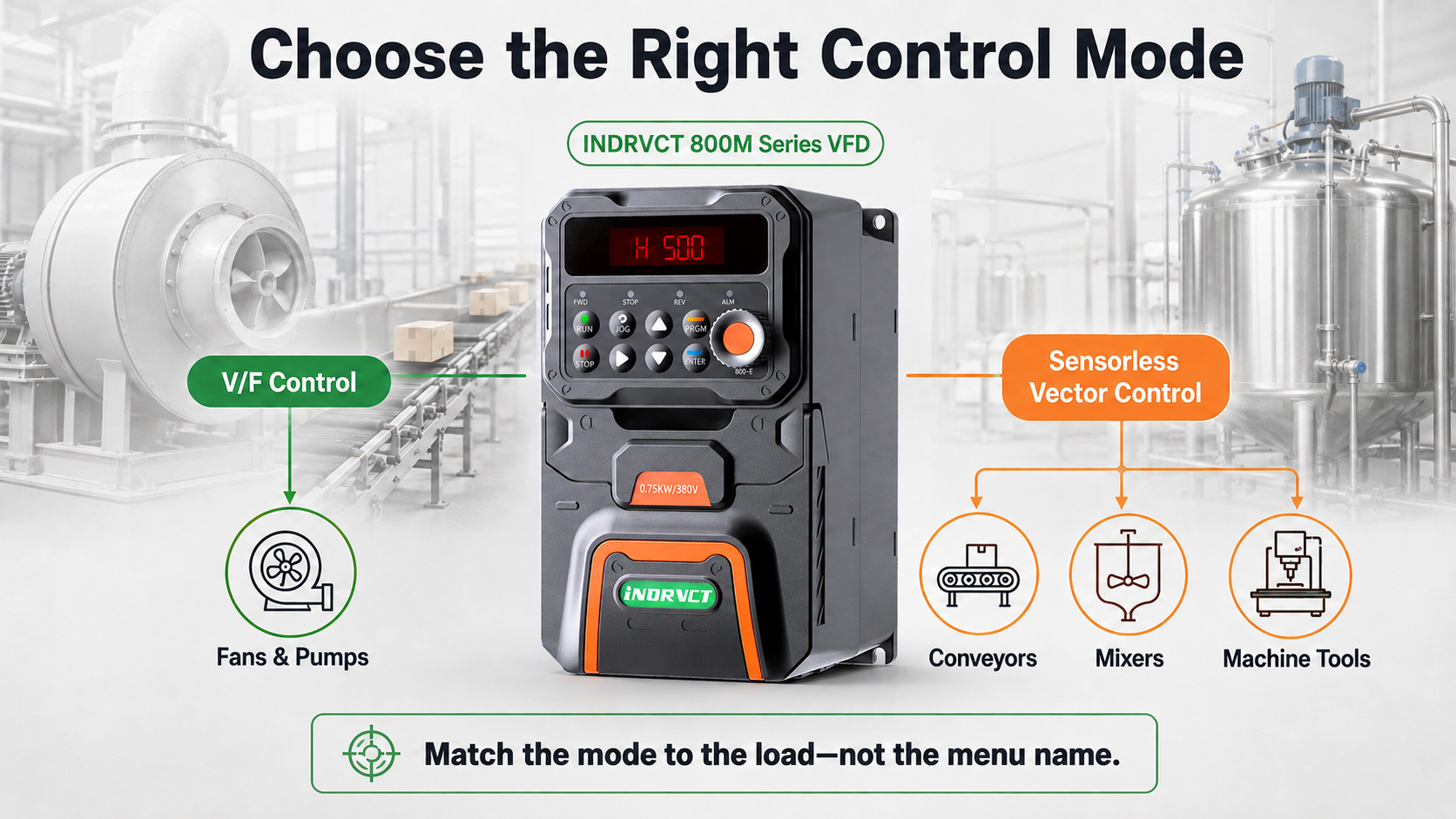
The better mode is not always the more advanced one. A simple fan with a stable load may run well in V/F control, while a conveyor, mixer, or machine tool may benefit from the stronger low-speed torque and load response of sensorless vector control. The correct choice depends on the motor, load, speed range, starting demand, and commissioning quality.
What Is V/F Control?
V/F control, also called volts-per-hertz control, adjusts the output voltage in relation to output frequency. The goal is to maintain suitable motor magnetic flux across the operating range.
Its main advantages are simplicity, broad compatibility, and straightforward commissioning. It usually requires less motor data than a vector mode and can be practical for applications where speed accuracy and dynamic torque response are not critical.
Typical uses include:
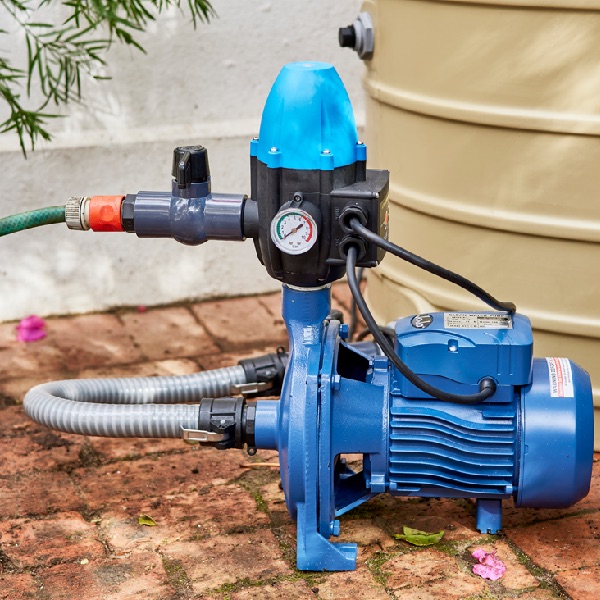
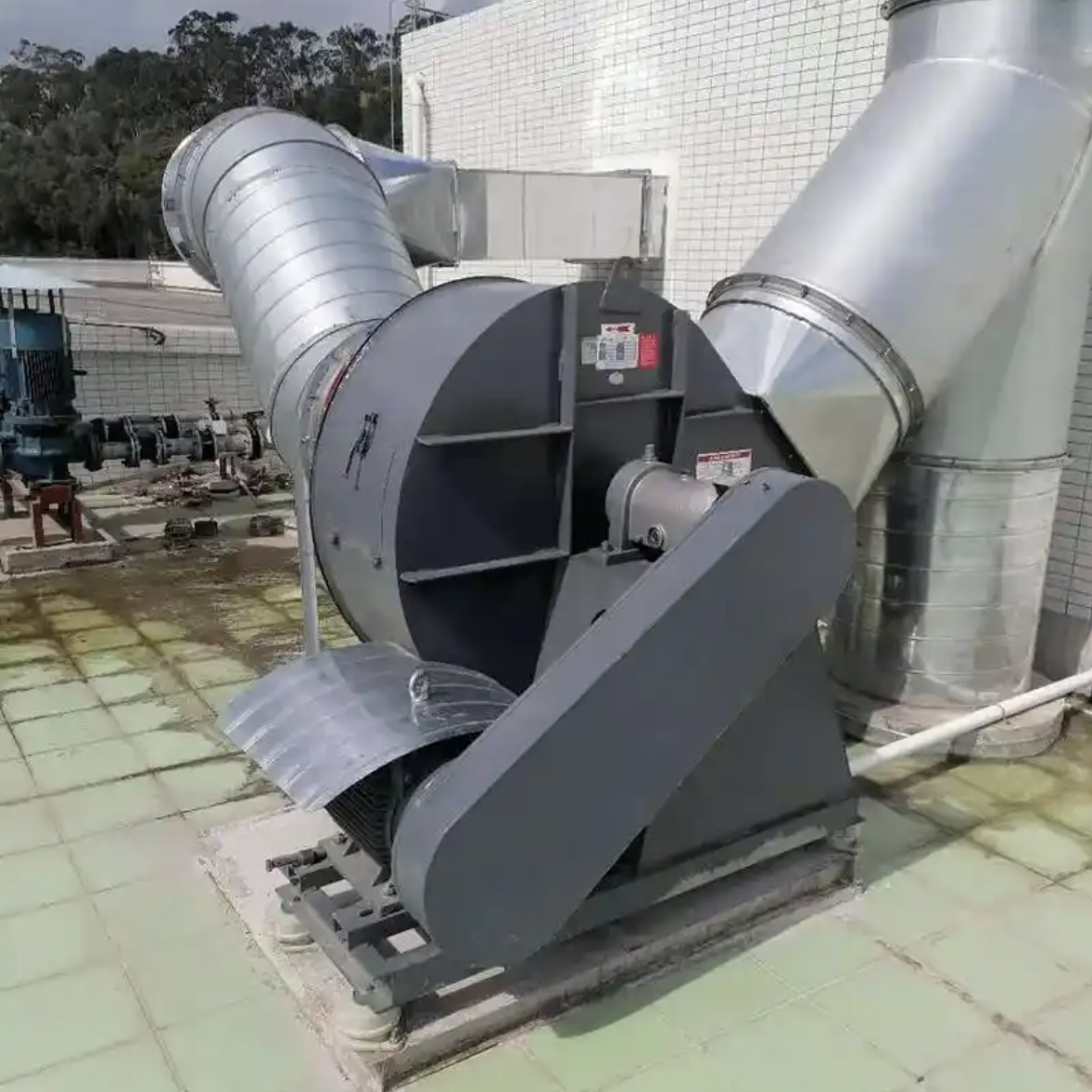
- Centrifugal fans
- Centrifugal pumps
- Simple ventilation systems
- Loads with gradual speed changes
- Multiple motors operated by one VFD, when the system is properly engineered
V/F control has limitations at low speed. Stator resistance and voltage drop become more significant as frequency falls, so available torque and speed stability may be lower than in a well-tuned vector mode. Torque boost can help in some cases, but excessive boost can increase motor current and heating.
What Is Sensorless Vector Control?
Sensorless vector control estimates motor flux and torque without using a shaft encoder. It relies on a motor model and measured electrical values to regulate the torque-producing and magnetizing components more effectively than basic V/F control.
SVC is useful when the application needs:
Higher starting torque
Better low-speed operation
Faster response to load changes
Improved speed stability without an encoder
Wider usable speed range
Because SVC depends on the motor model, accurate motor nameplate data is important. Many drives also provide a motor identification or self-learning function. Incorrect voltage, current, frequency, speed, or motor type data can reduce performance and may cause unstable operation.
V/F and SVC: Key Differences
| Comparison | V/F Control | Sensorless Vector Control |
| Control principle | Maintains a programmed voltage-to-frequency relationship | Estimates motor flux and torque from a motor model |
| Setup | Usually simpler | Requires accurate motor data and often motor identification |
| Low-speed torque | Moderate | Generally stronger when correctly tuned |
| Speed stability | Suitable for basic speed control | Better under changing load |
| Dynamic response | Slower | Faster |
| Multiple motors on one drive | Often more practical | Usually not the first choice because one motor model is used |
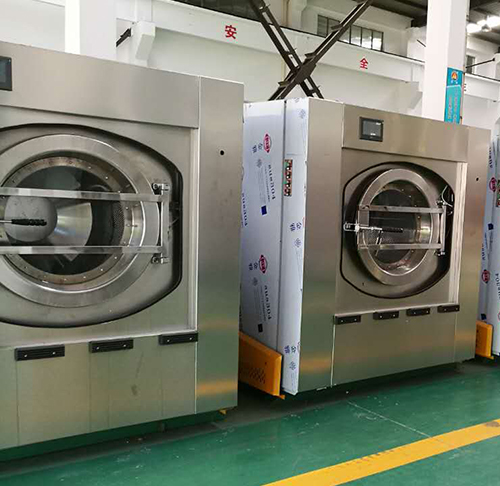
| Typical loads | Fans, pumps, simple continuous loads | Conveyors, mixers, machine tools, changing loads |
This table is a starting point. The final choice must consider the drive model, motor type, and process requirement.
When Should You Use V/F Control?
1. The load is simple and predictable
For a centrifugal fan or pump that changes speed gradually, V/F control can provide reliable operation without unnecessary commissioning complexity.
2. Precise low-speed torque is not required
If the machine normally runs in the middle or upper part of the speed range and does not need full torque near zero speed, V/F may be sufficient.
3. One VFD operates multiple motors
In a properly designed multi-motor system, V/F control is often easier because the drive is not trying to model one individual motor as precisely as SVC. Each motor still needs suitable protection, and combined current must be calculated correctly.
4. Fast commissioning is more important than peak performance
For straightforward installations, V/F control can reduce setup time. However, motor voltage, current, base frequency, minimum frequency, and acceleration settings still require verification.
When Should You Use Sensorless Vector Control?
1. High starting torque is required
Conveyors, mixers, extruders, and loaded machinery may need stronger torque during acceleration. SVC can regulate torque more effectively when motor data is correct.
2. The load changes during operation
If the process alternates between light and heavy load, sensorless vector control can hold speed more consistently than basic V/F control.
3. The machine operates at low speed
SVC can improve low-speed torque and stability, but motor cooling must still be considered. A standard motor’s shaft fan also slows down, so continuous low-speed torque may require independent cooling or a different operating limit.
4. Better response is needed without an encoder
SVC is a useful middle ground between simple V/F control and closed-loop vector control with encoder feedback. It improves performance without adding an external speed sensor, although it cannot provide the same zero-speed precision as a closed-loop system.
How the INDRVCT 800 Series Supports Both Modes
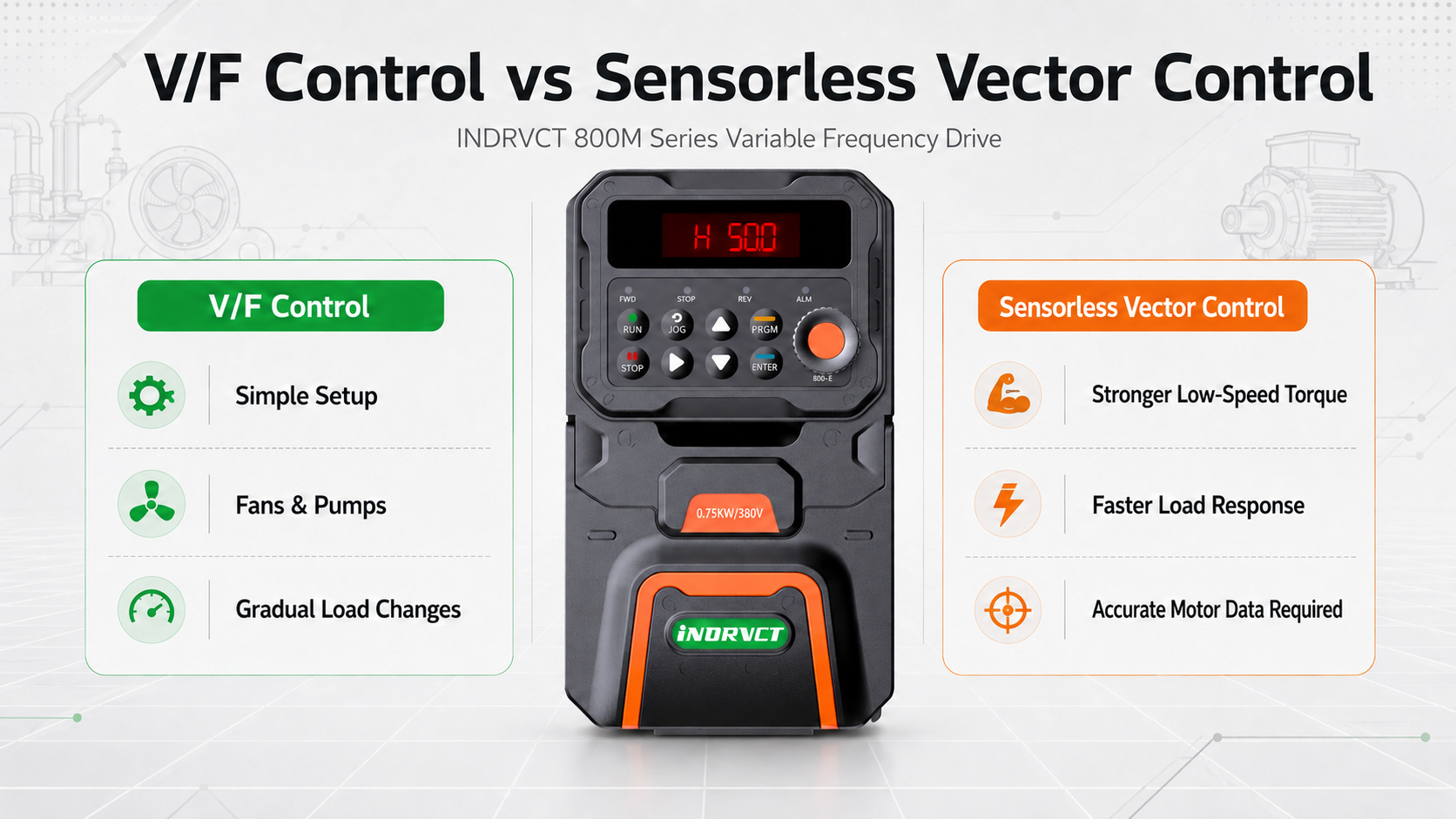
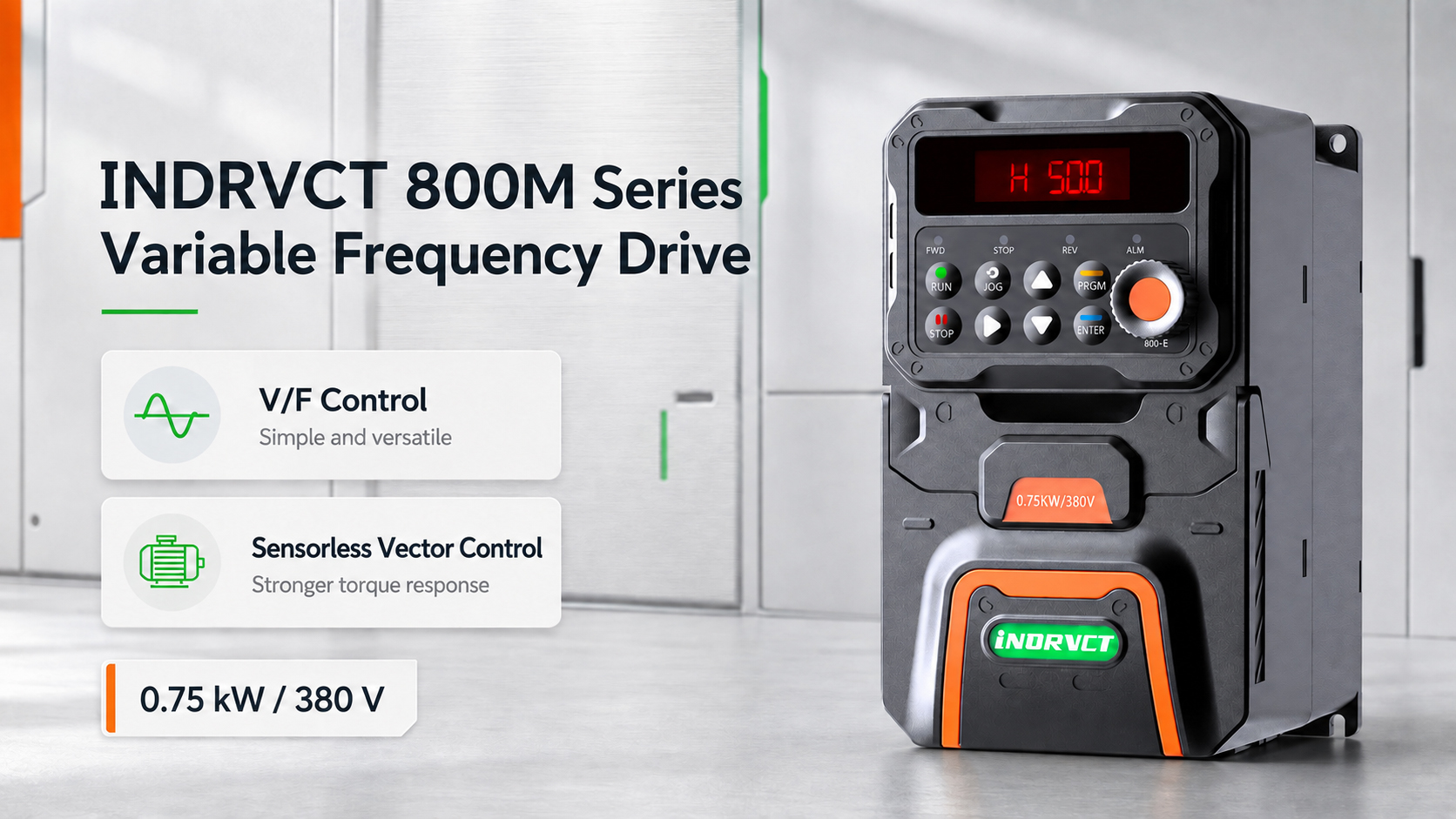
The INDRVCT 800 Series Variable Frequency Drive (VFD) supports V/F control and sensorless vector control for asynchronous and permanent magnet synchronous motors. Its sensorless vector mode is designed for strong starting performance, while the dual-mode structure allows a simpler V/F setup for appropriate applications.
The 800 Series also provides motor parameter self-learning, panel, terminal, and communication command sources, built-in PID, multi-speed operation, and Modbus RTU integration. These functions make it possible to adapt the drive to fans, pumps, conveyors, machine tools, and process-control equipment after the control mode has been selected correctly.
For cabinet installation, note that the 800 Series is an IP20 product. It should be protected from water, condensation, conductive dust, corrosive gas, and direct sunlight, with adequate cabinet ventilation.
A Practical Control Mode Selection Process
Step 1: Identify the motor
Record the motor type, rated voltage, current, frequency, speed, and power. Confirm whether one or several motors will be connected.
Step 2: Describe the load
Classify the machine as variable torque, constant torque, or constant power. Note the starting load, inertia, load changes, minimum speed, and required response.
Step 3: Define the performance target
Decide whether the system needs basic speed adjustment, stable low-speed torque, fast response, or precise speed regulation.
Step 4: Start with the simplest suitable mode
Use V/F for a simple application when it meets the performance target. Use SVC when the process requires better torque and speed response. Do not choose a mode only because its name sounds more advanced.
Step 5: Enter correct motor data
For SVC, motor data quality directly affects the model. Perform the required identification procedure only when the motor and machine can be placed in a safe condition.
Step 6: Test under real load
Check starting current, low-speed stability, motor temperature, vibration, noise, acceleration, deceleration, and response to load changes. Change one setting at a time and record the result.
Common Control Mode Mistakes
Using SVC without entering motor data
The drive cannot estimate motor behavior accurately if the nameplate values are wrong or incomplete.
Using V/F for a demanding low-speed load
The motor may start slowly, lose speed, or draw excessive current if the application requires torque that the selected setup cannot provide.
Increasing torque boost too quickly
More boost is not always better. Excessive voltage at low frequency can raise current and motor temperature.
Ignoring motor cooling
Better low-speed torque does not remove the thermal limits of the motor.
Changing several parameters together
If multiple settings are changed at once, it becomes difficult to identify which adjustment improved or worsened performance.
Frequently Asked Questions
Is sensorless vector control always better than V/F control?
No. SVC offers better torque and speed response, but V/F control can be simpler and fully adequate for fans, pumps, and other predictable loads.
Does SVC need an encoder?
No. Sensorless vector control estimates motor speed and flux without an encoder. Closed-loop vector control uses encoder feedback when higher precision is required.
Can I use SVC with several motors on one VFD?
It is generally not the preferred method because the drive model is based on one motor. A multi-motor system requires separate engineering and individual motor protection.
Why does the motor perform poorly after selecting SVC?
Check motor nameplate data, motor identification, wiring, current limit, acceleration time, and whether the selected drive and motor types are compatible.
Which mode should I try first for a fan?
For a basic centrifugal fan, V/F control is often a practical starting point. Move to SVC if the system needs better low-speed torque or stronger response to changing load.
Conclusion
Choose the VFD control mode from the actual performance requirement. V/F control favors simplicity and broad application, while sensorless vector control favors stronger torque and better response. INDRVCT can review the motor nameplate, load type, speed range, and control target to help select and commission the appropriate 800 Series operating mode.